01 / The challenge
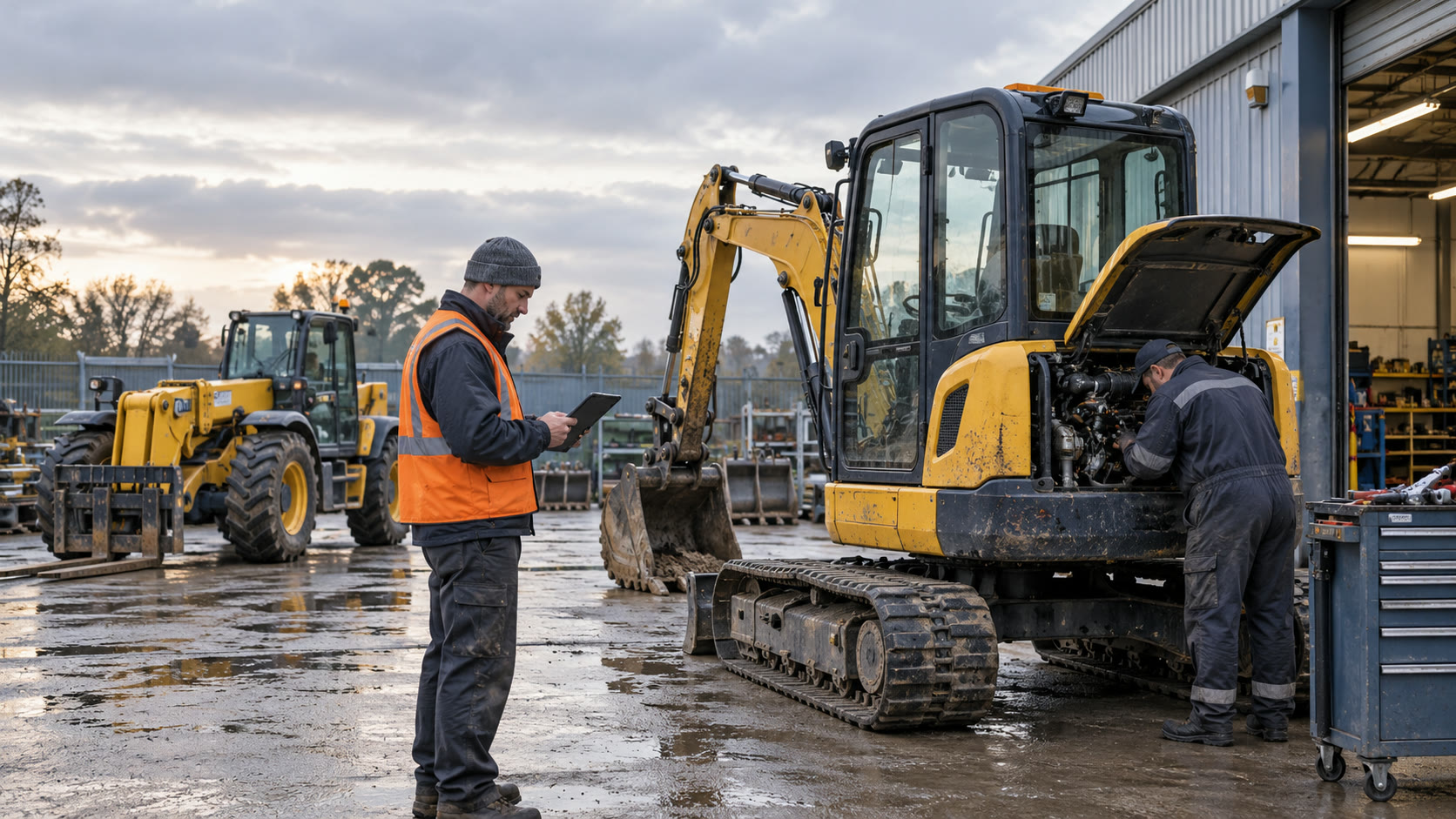
The owner identified the workshop as the business’s biggest operational challenge and asked us to help identify where AI could help. Equipment was returning from hire and spending too long out of service before it could be hired again.
The engagement team reports that additional equipment was being purchased to cover availability gaps. That added assets needing servicing and repair without first resolving the workshop bottleneck.
A customer promise crosses the whole operation
- Enquiry
- Check readiness
- Resolve blockers
- Confirm release
- Dispatch
Could the business fulfil more hires by getting the equipment it already owned ready sooner?
03 / What we found
The missing connections were operational.
Low utilisation
Low utilisation needed an explanation.
The assessment calculated 17.5% utilisation across 354 equipment records for January–July 2026. Time off hire did not, by itself, show whether equipment was waiting for repairs, held up by parts or simply not in demand. We connected rental records, workshop boards and team knowledge to investigate where the return-to-rehire process was stalling.
“Available” did not always mean ready to hire.
Software status, service condition and physical readiness did not combine into one dependable view. A return configuration could mark an item available without an inspection step.
Servicing and parts were out of step.
Service-scheduling tools existed but were underused. The team reports that spares were often ordered only when servicing became due, leaving equipment waiting for parts.
Unfulfilled demand was hard to follow.
Enquiry records did not reliably show whether requests became hires, were fulfilled with substitutes, remained open or were genuinely lost.
Workshop priorities did not consistently reflect the work.
Job age, repair effort, parts readiness and customer demand were not consistently considered together. Smaller repairs could wait behind larger jobs.
Missed inspections had no dependable catch-up step.
If urgent work displaced a three-week inspection slot, equipment could wait until the next cycle, extending an interval to as much as six weeks.
One request traced to the constraint
- 1
- walk-in request
- 3
- units awaiting repair
- ~3 months
- discovered to be waiting
The recorded gap
Site A board, 21 Feb–15 Aug 2026.
The missed-slot effect
- Week 0Inspected
- Week 3Slot missed
- Week 6Next slot
Six-week gap if no catch-up happens sooner.
At Site A, spreadsheet boards recorded 1.71 times as many work episodes entering the board as receiving a green completion mark between 21 February and 15 August 2026.
04 / The response
Four connected changes before a wider AI rollout.
Make servicing happen on time.
Use the existing scheduling capability, keep relevant readings current and make responsibility for completing due work clear.
Prepare parts before they are needed.
Connect upcoming services with parts requirements, stock records and early reorder decisions.
Capture and follow up unfulfilled demand.
Record the request, required date, reason it could not be supplied, substitute offered and eventual outcome.
Keep workshop work moving.
Review blockers and priorities daily, protect capacity for older and quick jobs, recover missed inspections and clarify the approval path for parts.
Potential AI assistance includes interpreting service-parts descriptions, structuring enquiry notes, summarising conflicting readiness information and preparing explained repair priorities for staff review. These remain proposals. Repair priorities, purchasing and equipment release remain human responsibilities.
The recommendations use ordinary software for schedules, stock calculations, reminders and fixed rules. AI is considered where interpreting varied information or assembling context offers a clear advantage.
05 / Current position
Implement a focused change. Measure the business result.
The engagement team reports that service schedules are being integrated into the existing software using a capability that had previously been underused. The engagement remains in progress and implementation is ongoing.
Provisional AI readiness
29–44 / 100Level 2 of 5 · Building foundations
Assessment dated 4 October 2026
Maturity path
- Level 1Reactive0–<20
- Level 2Building foundations20–<50Current
- Level 3Prepared for a supervised pilot50–<70
- Level 4Controlled use70–<85
- Level 5Ready to scale85–100
Readiness profile
The proposed first trial would track fulfilled requests, confirmed bookings, coordination time, causes of waiting and compliance with service and readiness checks. Any AI-assisted prioritisation should be compared with a simple priority rule before deciding whether it adds value.
About this study
Based on the company’s Plant-Hire Transformation Assessment, dated 4 October 2026. Periods differ by source and are stated beside the relevant figures. Client and branch identities remain anonymised.